
 info@shyping.com
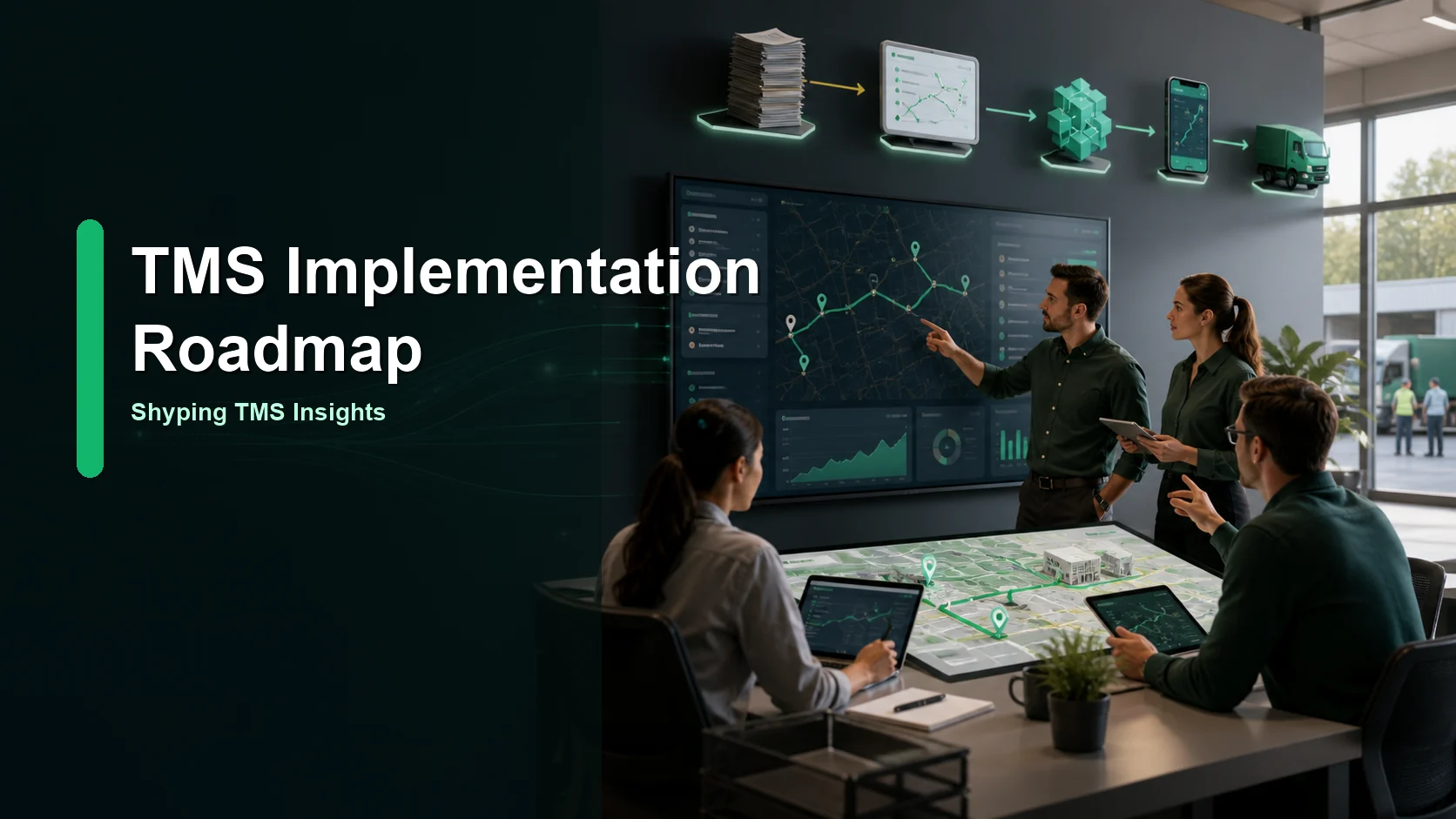
A TMS implementation is the process of moving transportation and delivery operations into a connected transportation management system. For last-mile delivery teams, it includes mapping current workflows, configuring route planning, preparing order and driver data, onboarding dispatchers and drivers, integrating customer communication, and measuring results after go-live.
The best TMS implementation is not only a software installation. It is a logistics transformation project. The system should make daily work easier for dispatchers, drivers, customer support, managers, and end customers.
Shyping supports TMS implementation through a modular last-mile delivery platform and professional services that include customer onboarding, logistics process transformation, efficiency improvement, digital transformation, custom solutions, and Transportleader expertise.
Why TMS implementation matters
Many delivery teams start with spreadsheets, phone calls, whiteboards, manual route plans, and separate customer support tools. That can work at low volume, but it becomes fragile as deliveries, drivers, service rules, and customer expectations grow.
A TMS implementation helps replace scattered work with one operational flow:
- Orders enter the system
- Routes are planned and optimized
- Drivers receive clear assignments
- Dispatchers monitor progress in real time
- Customers receive updates
- Proof of delivery is captured
- Managers review performance data
This connected flow is what allows a transportation management system to improve delivery accuracy, reduce avoidable calls, shorten driving distances, and create a more reliable customer experience.
Quick answer: what are the steps in a TMS implementation?
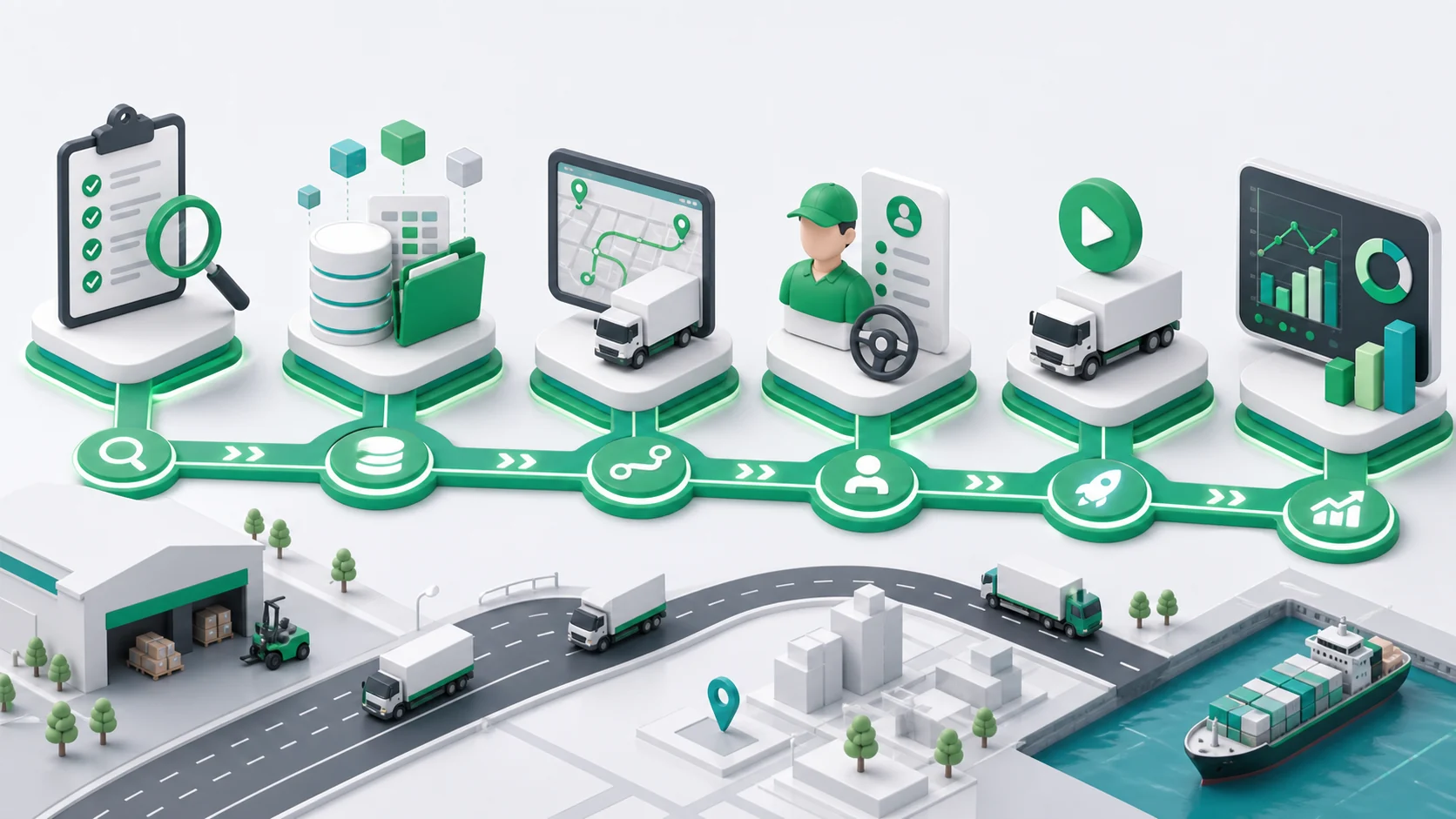
A practical TMS implementation usually follows seven steps:
- Audit the current delivery process
- Define goals and success metrics
- Prepare order, driver, vehicle, and customer data
- Configure route planning and service rules
- Train dispatchers, drivers, and support teams
- Launch with controlled routes or locations
- Review performance and continuously improve
Shyping’s professional services help delivery teams move through these steps with less risk and clearer operational ownership.
Step 1: Audit the current delivery process
Before implementing TMS software, the team needs to understand how deliveries actually work today.
This audit should answer:
- How are orders received?
- Who plans routes?
- What rules affect each delivery?
- How are drivers assigned?
- How are customers notified?
- How is proof of delivery captured?
- What causes failed deliveries?
- Where does customer support lose visibility?
- What data is missing from performance reports?
The goal is not to criticize the current process. The goal is to find the points where manual coordination creates cost, delay, or customer uncertainty.
Shyping’s Professional Services are designed to understand unique logistics challenges and transform processes into more efficient, productive, and customer-centric workflows.
Step 2: Define measurable TMS goals
A TMS project should have clear operational goals. Without measurable targets, teams may launch the software but miss the business outcome.
Useful implementation goals include:
- Reduce customer service calls
- Improve on-time delivery rate
- Increase delivery-window accuracy
- Shorten driving distances
- Improve driver productivity
- Reduce failed delivery attempts
- Digitize proof of delivery
- Improve dispatcher visibility
- Create daily performance reporting
These goals should connect to the modules being implemented. For example, route planning should influence distance and time-window accuracy. The driver app should influence adoption and proof of delivery. Backoffice monitoring should influence exception handling and customer communication.
Step 3: Prepare operational data
TMS implementation depends on clean data. If addresses, time windows, vehicle capacity, driver availability, customer preferences, or delivery instructions are inconsistent, the system will have less reliable output.
Important data to prepare includes:
| Data type | Why it matters |
|---|---|
| Delivery addresses | Enables accurate route planning and geocoding |
| Time windows | Helps the system build realistic schedules |
| Vehicle types | Supports mixed fleet planning and capacity rules |
| Driver availability | Keeps dispatch assignments realistic |
| Service duration | Improves route timing and delivery-window accuracy |
| Customer contact details | Enables proactive notifications |
| Proof-of-delivery rules | Ensures drivers capture the right evidence |
| Delivery scenarios | Supports age checks, special instructions, or customer-specific rules |
This is where professional onboarding matters. The better the data foundation, the smoother the launch.
Step 4: Configure route planning and service rules
Route planning is one of the highest-impact parts of a TMS implementation. Shyping’s Route Planning supports route optimization across mixed fleets, delivery scenarios, traffic conditions, vehicle types, time windows, and historical data.
During implementation, teams should configure:
- Fleet types
- Delivery areas
- Driver shifts
- Time-window rules
- Delivery priorities
- Customer-specific instructions
- Proof-of-delivery requirements
- Dispatch exception workflows
- Day-specific scenarios
Configuration should reflect the real operation. If the system is too generic, dispatchers will keep working around it. If it is configured around daily reality, it becomes a trusted operating layer.
Step 5: Train dispatchers, drivers, and support teams
A TMS succeeds when people use it confidently. That means implementation must include training for each role.
Dispatchers need to know how to monitor routes, support drivers, update orders, communicate with customers, and respond to exceptions. Drivers need a simple mobile workflow with clear route guidance, delivery instructions, and proof-of-delivery steps. Customer support needs visibility into delivery status so they can answer customer questions quickly.
Shyping’s Driver Application is built for quick onboarding and efficient delivery flows. The Backoffice Application helps teams monitor drivers in real time, manage routes, communicate with customers, and review performance.
Step 6: Launch in controlled phases
A phased launch reduces risk. Instead of switching every route at once, many teams begin with a pilot route, depot, city, customer segment, or delivery scenario.
During the pilot, measure:
- Route completion time
- Driver adoption
- Dispatcher workload
- Failed delivery causes
- Customer calls
- Proof-of-delivery completion
- Data accuracy
- Integration reliability
This controlled launch gives the team time to refine configurations before scaling.

Step 7: Improve after go-live
TMS implementation does not end on launch day. The highest value comes when managers use delivery data to improve operations continuously.
Post-launch reviews should look at:
- Which routes are consistently late
- Which areas create the most exceptions
- Which drivers need coaching or support
- Which customer instructions prevent failed attempts
- Which delivery scenarios need new rules
- Which integrations need improvement
- Which reports help managers make better decisions
Shyping’s professional services include efficiency and productivity support, digital transformation, custom solutions, and Transportleader expertise for teams that want logistics experts available beyond the initial software rollout.
TMS implementation checklist
Use this checklist before go-live:
- Current delivery workflow documented
- Implementation goals agreed
- Order and customer data prepared
- Driver and vehicle data prepared
- Route planning rules configured
- Proof-of-delivery rules configured
- Dispatcher workflows tested
- Driver app training completed
- Customer notifications tested
- Performance dashboards reviewed
- Pilot launch plan approved
- Post-launch optimization plan scheduled
Frequently asked questions
What is TMS implementation?
TMS implementation is the process of configuring, launching, and adopting transportation management system software across delivery planning, dispatch, driver workflows, customer communication, proof of delivery, and reporting.
How long does TMS implementation take?
The timeline depends on delivery volume, data quality, integrations, number of locations, and workflow complexity. A focused implementation can begin with a controlled pilot before scaling to more routes or regions.
Why do TMS projects fail?
TMS projects often struggle when data is poor, workflows are not mapped, drivers are not trained, goals are unclear, or the software is treated as a technical installation instead of an operational change.
How does Shyping support TMS implementation?
Shyping supports implementation through modular TMS software, customer onboarding, logistics process transformation, efficiency improvement, digital transformation, custom solutions, and Transportleader professional services.
What should a company prepare before implementing a TMS?
A company should prepare delivery addresses, driver and vehicle data, customer notification rules, proof-of-delivery requirements, route constraints, delivery scenarios, and success metrics.
Next step
If your delivery team is ready to move beyond manual coordination, Shyping can help you plan, configure, launch, and improve a connected last-mile TMS workflow.
Explore Shyping Professional Services or contact Shyping to discuss your delivery operation.